
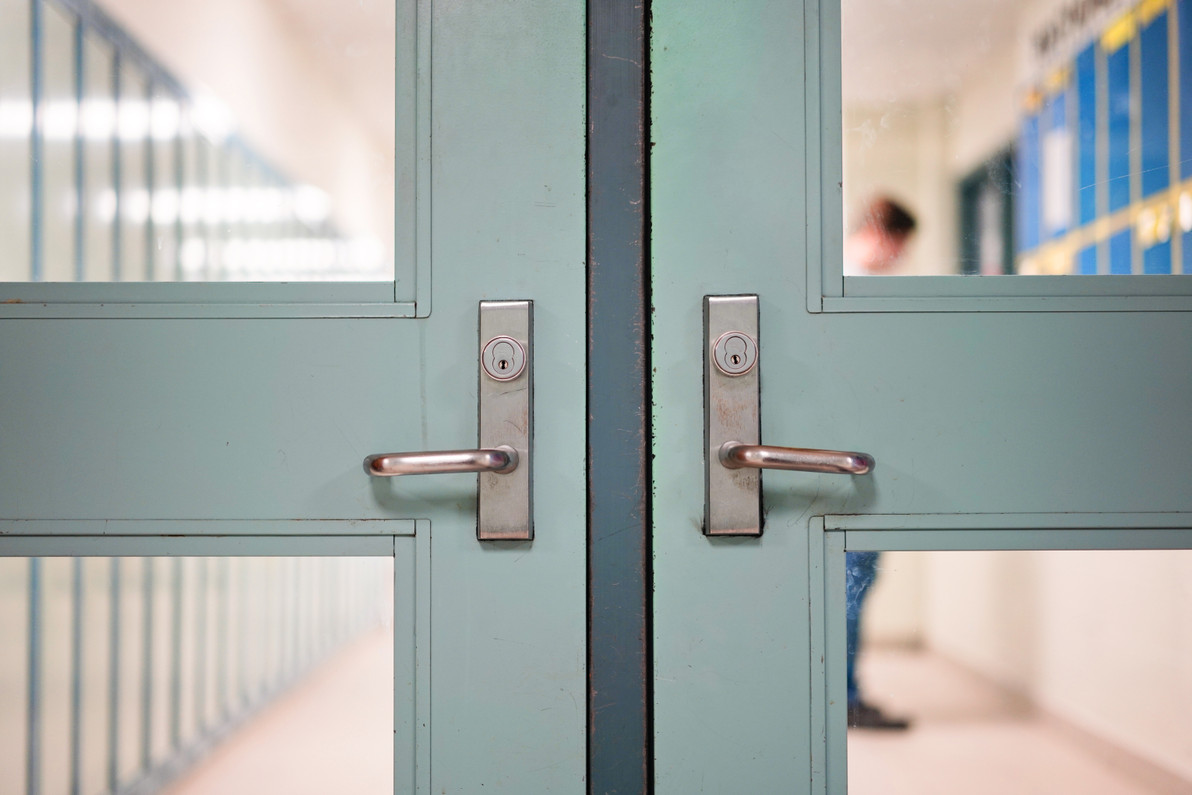
Best Lockdown Solutions for Elementary Campuses: Complete K-5 School Lockdown Guide | Affinitech Store
When an emergency happens at an elementary school, the first minutes matter most. Young students depend completely on adults to keep them safe, so a lockdown has to be fast, simple and reliable for every teacher, substitute and staff member in the building. The best lockdown solutions for elementary campuses combine code-compliant classroom door locks, access control that can secure every door at once, silent panic alerts, clear announcements and integrated video surveillance, all backed by trained staff and practiced procedures.
This guide is part of the Affinitech school access control series. For a broader overview, start with our pillar article, School Access Control Systems: Complete Guide for K-12 Schools & Universities. This article focuses on one question elementary schools face: which school lockdown systems and technologies work best for K-5 campuses.
Quick Answer: The best lockdown solution for an elementary campus is a layered system: classroom doors that lock from inside without opening the door and always allow free exit, an access control system that can lock every exterior and interior door with one action, silent panic buttons or mobile alerts that notify administrators and law enforcement, PA and audio announcements, and security cameras that let staff and first responders see what is happening. Each layer should be simple enough for any adult in the building to activate in seconds.
Is Your Elementary School Ready for a Lockdown?
Affinitech can evaluate your doors, locks, access control, cameras and communication systems, then recommend a lockdown solution that fits your campus and budget.
Request a School Security AssessmentWhy Elementary Schools Need a Dedicated Lockdown Strategy
Lockdown planning for elementary schools differs from planning for middle schools, high schools or universities. K-5 campuses have unique conditions that shape which lockdown technologies work best:
- Young students cannot act independently. Children in kindergarten through fifth grade rely on teachers and staff to lock doors, give directions and keep them calm.
- Many adults rotate through the building. Substitutes, paraprofessionals, specialists and volunteers must be able to activate a lockdown without special keys or training-heavy procedures.
- Students are often outside the classroom. Recess, lunch, specials, restroom breaks and arrival and dismissal all create moments when students are spread across the campus.
- Older buildings are common. Many elementary schools still have classroom doors that can only be locked from the hallway with a key.
- Parents and visitors arrive throughout the day. The front entrance must stay welcoming while still being able to lock instantly.
The goal is a lockdown that any adult can start in seconds, that secures the building automatically, and that keeps students and staff safe without blocking emergency exit.
School Lockdown Statistics
Federal education data shows how central lockdown preparation has become in U.S. schools, and where physical security gaps remain.
96% of Public Schools Drilled Students on Lockdown
According to the National Center for Education Statistics (NCES), about 96 percent of public schools had drilled students on a lockdown procedure during the 2021–22 school year.
96% Have a Written Active Shooter Plan
NCES reports that the share of public schools with a written plan for active shooter scenarios rose from 84 percent in 2009–10 to 96 percent in 2021–22.
About 1 in 4 Schools Lacked Classroom Doors That Lock From Inside
In 2019–20, about 73 percent of public schools had classrooms equipped with locks that could be locked from the inside, leaving roughly one in four without that capability, according to NCES data reported by Pew Research Center.
Only 40% Had Panic Buttons Connected to Law Enforcement
The same NCES data showed that 40 percent of public schools had panic buttons or silent alarms directly connected to law enforcement in 2019–20.
Sources: U.S. Department of Education, National Center for Education Statistics (NCES), School Survey on Crime and Safety (SSOCS), 2009–10, 2019–20 and 2021–22; Pew Research Center analysis of NCES data, 2022.
What Is a School Lockdown System?
A school lockdown system is the combination of door hardware, access control, alerting, communication and video technology that allows a school to quickly secure its building and classrooms when a threat is present inside or near the campus.
Definition — Lockdown: Under the widely used Standard Response Protocol (SRP), a lockdown is the protocol used when a threat or hazard is inside the building. Its directive is "Locks, Lights, Out of Sight," meaning occupants secure individual rooms and stay quiet and in place until released.
Lockdown vs. Secure (Lockout) vs. Shelter
| Protocol | When It Is Used | What Technology Must Do |
|---|---|---|
| Lockdown | Threat or hazard inside the building | Lock exterior and classroom doors, alert staff and law enforcement, share live video |
| Secure (Lockout) | Threat or hazard outside the building | Lock exterior doors while classes continue inside, pause visitor entry |
| Hold | Hallways need to be kept clear, such as a medical emergency | Announce instructions; doors typically unchanged |
| Shelter | Severe weather or environmental hazard | Announce the hazard and safety strategy |
| Evacuate | Occupants must move to another location | Announce destination; doors must allow free exit |
A good lockdown system supports more than one protocol. For example, the same access control platform that runs a full lockdown should also be able to run a Secure (lockout) that locks only exterior doors.
The Layers of an Elementary School Lockdown Solution
No single product delivers a complete lockdown. The most effective elementary campuses use several layers that work together.
Layer 1: Classroom Door Locks
Classroom doors are the most important barrier during a lockdown. Teachers should be able to lock the door from inside the room without stepping into the hallway, and anyone inside must still be able to open the door to exit. Options include classroom security (intruder) function locks with an inside thumbturn or push button, electronic classroom locks connected to the access control system, and wireless locksets that can be locked remotely. Browse door hardware and HES electric strikes and locking hardware.
Layer 2: Exterior Door Access Control
An electronic access control system lets the school lock every exterior door at once, disable regular credentials during a lockdown and keep emergency responder access available. Network door controllers and card readers form the foundation of this layer. Learn more in Securing Elementary School Entrances with Access Control.
Layer 3: Lockdown Triggers and Panic Alerts
Staff need multiple ways to start a lockdown: a button in the front office, a button or keypad in classrooms, a mobile app, a wearable badge or a command from the access control software. Hardwired buttons can connect to the access control system through network I/O relay modules and I/O devices, so one press can lock doors and send alerts.
Layer 4: Announcements and Notification
Every room, hallway, gym and playground needs to hear the lockdown instruction clearly. Network audio systems, public address systems and outdoor speakers can deliver pre-recorded lockdown messages automatically when a lockdown is triggered.
Layer 5: Video Surveillance and Situational Awareness
Security cameras help administrators and law enforcement see where a threat is, which areas are clear and whether doors are secured. AI cameras can add real-time alerts. See our K-5 school security camera guide for placement recommendations.
Layer 6: Front Entrance and Visitor Control
Video intercoms and visitor management keep the main entrance locked while still allowing verified visitors in. During a lockdown, visitor entry should pause automatically. Explore network door stations and intercom cameras.
Best Lockdown Solutions for Elementary Campuses Compared
| Lockdown Solution | Best For | Strengths | Considerations |
|---|---|---|---|
| Classroom security (intruder) function locks | Schools without inside-locking classroom doors | Teachers lock from inside; free exit maintained; no network required | Each door locked individually; no central status |
| Electronic classroom locks on access control | Schools wanting one-touch, building-wide lockdown | Locks all classrooms at once; door status visible centrally | Higher cost; requires power, network and integration |
| Wireless locksets | Existing buildings where running wire is difficult | Remote lockdown without major construction | Battery maintenance; wireless coverage planning |
| Cloud access control lockdown | Schools and districts wanting remote activation | Trigger lockdown from a browser or phone; multi-site management | Plan for internet outages and local fallback |
| Hardwired panic buttons | Front offices and classrooms | Fast, simple, always in the same place | Fixed location; staff may not be near one |
| Mobile and wearable panic alerts | Recess, lunch, specials and staff on the move | Alert from anywhere on campus | Device management and coverage testing |
| Integrated video and access control | Schools wanting situational awareness | See doors and camera views together; share video with responders | Requires compatible platforms |
Not Sure Which Lockdown Layers Your Campus Needs?
Every elementary school has different doors, buildings and budgets. Affinitech can help you prioritize upgrades and build a lockdown plan in phases.
Contact an Education Security Specialist Get a QuoteHow an Integrated Lockdown Works
When lockdown technologies are integrated, a single action can start a coordinated response across the campus. Capabilities vary by platform, but a typical sequence looks like this.
- A staff member triggers the lockdown. The trigger can be a panic button, keypad, mobile app, wearable device or software command.
- Exterior doors lock. The access control system secures every exterior entrance and pauses visitor entry.
- Classroom doors lock where electronic locks are installed. Rooms with mechanical locks are secured by staff from inside.
- Regular credentials are suspended. Student and general staff badges stop working, while emergency responder credentials remain active.
- Announcements play. A pre-recorded lockdown message plays over PA speakers indoors and outdoors.
- Notifications are sent. Administrators, district security and, where configured, law enforcement receive alerts.
- Live video is available. Authorized staff and responders can view cameras to locate threats and confirm door status.
- The lockdown is released. Only authorized personnel end the lockdown, and the system logs every event for review.
Lockdown Solutions by Elementary Campus Area
| Campus Area | Recommended Lockdown Measures |
|---|---|
| Main entrance and vestibule | Access-controlled doors, video intercom, automatic visitor pause during lockdown |
| Front office | Hardwired panic button, lockdown control workstation, camera monitoring |
| Classrooms | Inside-locking classroom doors, electronic or wireless locks where possible, classroom panic button or keypad |
| Gym and cafeteria | Access-controlled entries, PA coverage, mobile or wearable alerts for staff |
| Library and specials rooms | Inside-locking doors, PA coverage, clear lockdown spaces out of sight |
| Playground and recess areas | Outdoor speakers, wearable alerts for supervising staff, cameras on perimeter |
| Bus loop and parent pickup | Cameras, outdoor speakers, Secure (lockout) procedures for nearby threats |
| Portable classrooms | Inside-locking doors, wireless locks, reliable announcement and alert coverage |
Lockdown Platforms Available From Affinitech
Several manufacturers Affinitech carries offer lockdown capabilities for schools. Features and licensing change over time, so confirm specific capabilities with Affinitech before purchasing.
Avigilon Alta
Avigilon Alta is a cloud-native platform combining access control and video. Avigilon states that Alta's Flexible Lockdown feature is included at no extra cost, and that lockdown plans can be activated remotely or from on-site devices such as panic buttons or Smart Keypad Readers. This makes Alta a strong fit for elementary schools and districts that want remote lockdown activation alongside unified video. Browse the full Avigilon product line.
Lenel Access Control
Lenel enterprise access control is well suited to districts that manage many buildings from a central platform and need programmable lockdown and threat-level responses across campuses.
HID Global Readers and Credentials
HID Global readers and credentials work with many access control platforms. During a lockdown, credential permissions can be restricted centrally while responder access is preserved.
Axis Communications Network Door Stations and Audio
Axis Communications offers network door stations, intercoms and network audio that can support lockdown announcements and secure visitor entry as part of an integrated system.
Power and Infrastructure
Lockdown systems must keep working during power interruptions. Life Power Safety power solutions, together with network switches and PoE devices, help keep controllers, locks, readers and cameras running when they are needed most.
Fire Code and Life Safety Compliance
Lockdown hardware must never trap occupants or block emergency responders. The NFPA 101 Life Safety Code permits classroom doors to be locked to prevent unwanted entry, but only when specific conditions are met.
| Requirement | What It Means for Elementary Schools |
|---|---|
| Lock without opening the door | Teachers must be able to lock the classroom door from inside without stepping into the hallway |
| Free egress from inside | The door must unlock and unlatch from inside without a key, tool, or special knowledge or effort |
| Limited releasing operations | Exiting the room must be simple and intuitive, typically one motion |
| Remote locks unlockable from inside | If doors are locked remotely by an access control system, occupants must still be able to open them from inside |
| Responder access | Doors must be unlockable from outside with a key or other approved means |
| Approval by the AHJ | Locking methods must be acceptable to the local authority having jurisdiction |
Temporary barricade devices are sometimes marketed to schools. Many of these devices can delay emergency exit and prevent responders from entering, and they may conflict with fire and life safety codes. Schools should consult their local fire marshal before purchasing any add-on locking device.
Important: Code adoption and requirements vary by state and jurisdiction. This article provides general educational information and should not be treated as legal, fire code or life safety advice. Always consult your local authority having jurisdiction (AHJ) and fire marshal.
Alyssa's Law and Silent Panic Alarms
Alyssa's Law is the name used for state laws that require or allow schools to use silent panic alarms to quickly summon emergency responders. Stateline reported in 2026 that 13 states have laws mandating or allowing such devices, with additional states considering similar legislation. Requirements differ significantly: some states require classroom panic technology, some require wearable alerts for certain staff, and others simply permit schools to adopt them.
Elementary schools should confirm their state's current requirements and choose lockdown platforms that can integrate panic alerts with access control, announcements and video.
Budget Planning for Elementary Lockdown Solutions
Lockdown upgrades can be phased to match budget cycles. Many schools start with the highest-impact, lowest-cost improvements, then expand.
| Priority | Upgrade | Why It Matters |
|---|---|---|
| 1 | Inside-locking classroom door hardware | Ensures every classroom can be secured quickly by the teacher |
| 2 | Access control on exterior doors | Enables building-wide lockout and lockdown with one action |
| 3 | Panic buttons and lockdown triggers | Gives staff fast ways to start a lockdown and request help |
| 4 | PA and outdoor audio integration | Ensures everyone, including students outside, hears the instruction |
| 5 | Camera coverage and video integration | Improves situational awareness for staff and responders |
| 6 | Electronic or wireless classroom locks | Allows all classrooms to be locked centrally |
Public schools may be able to use state school safety funding or federal grant programs for some upgrades. Affinitech's State, Local, Federal and Education sales team can help with procurement.
Step-by-Step Lockdown Implementation Guide
Step 1 — Audit Every Door
Document each exterior and classroom door, its lock type, whether it locks from inside and whether it is connected to access control.
Step 2 — Review Emergency Procedures
Confirm the school's lockdown, secure, hold, shelter and evacuate procedures and identify where technology can support each one.
Step 3 — Involve the Fire Marshal and Local Law Enforcement
Review planned hardware and procedures with the authority having jurisdiction and local responders before purchasing.
Step 4 — Prioritize Classroom Door Security
Address classrooms that cannot be locked from inside first.
Step 5 — Connect Exterior Doors to Access Control
Enable building-wide lockdown and lockout from one command.
Step 6 — Add Multiple Lockdown Triggers
Install panic buttons in the front office and key locations, and consider mobile or wearable alerts for staff who move around campus.
Step 7 — Integrate Announcements and Video
Connect PA, outdoor speakers and cameras so a lockdown triggers announcements and gives staff live visibility.
Step 8 — Train All Adults
Include teachers, substitutes, paraprofessionals, specialists, office staff, custodians and volunteers.
Step 9 — Drill and Test
Practice lockdown drills appropriate for young students and test every trigger, lock and announcement regularly.
Step 10 — Review and Improve
Use system logs and drill debriefs to find gaps and plan the next phase of upgrades.
Elementary School Lockdown Checklist
- ☐ Every classroom door can be locked from inside without opening the door
- ☐ Every classroom door allows free exit from inside
- ☐ Exterior doors can be locked with one action
- ☐ Lockdown and Secure (lockout) can be triggered separately
- ☐ Panic buttons are installed in the front office and key locations
- ☐ Staff away from classrooms have a way to trigger alerts
- ☐ Regular credentials can be suspended during lockdown while responder access remains
- ☐ Lockdown announcements reach indoor and outdoor areas
- ☐ Cameras cover entrances, hallways and outdoor student areas
- ☐ Visitor entry pauses automatically during lockdown
- ☐ Locks, controllers and cameras have backup power
- ☐ Hardware and procedures reviewed by the fire marshal or AHJ
- ☐ Substitutes and volunteers are trained on lockdown procedures
- ☐ Lockdown systems are tested and drilled regularly
Common Lockdown Mistakes and Better Approaches
| Mistake | Better Approach |
|---|---|
| Classroom doors that only lock from the hallway with a key | Install locks that can be engaged from inside the classroom |
| Relying on barricade devices | Use code-compliant locking hardware approved by the AHJ |
| Only one way to trigger a lockdown | Provide multiple triggers, including fixed buttons, software and mobile alerts |
| Forgetting students outside | Add outdoor speakers and wearable alerts for recess and pickup staff |
| No plan for substitutes | Keep lockdown instructions simple and include substitutes in training |
| Disconnected systems | Integrate access control, audio, alerts and video |
| Never testing hardware | Test locks, triggers and announcements on a regular schedule |
Recommended Product Categories for Elementary Lockdown Solutions
Access Control Systems
Centralized door control for building-wide lockdown and lockout.
Explore Access Control Systems
Door Hardware
Locks, strikes and hardware for classroom and exterior doors.
Network Door Controllers
Controllers that connect doors, readers and lockdown triggers.
Network I/O Relay Modules
Connect panic buttons, strobes and other devices to lockdown automation.
Shop Network I/O Relay Modules
Public Address and Network Audio
Deliver clear lockdown announcements indoors and outdoors.
Cloud-Based Video Surveillance
Remote access to live video during an emergency.
Explore Cloud-Based Video Surveillance Solutions
Quick Answers: Elementary School Lockdown Solutions
What is the best lockdown solution for an elementary school?
The best lockdown solution is a layered system combining inside-locking classroom doors, access control on exterior doors, multiple lockdown triggers, silent panic alerts, PA announcements and integrated video surveillance.
What is the difference between a lockdown and a lockout?
A lockdown is used when a threat is inside the building and occupants secure their rooms. A lockout, called Secure in the Standard Response Protocol, is used when a threat is outside, and exterior doors are locked while activities continue inside.
Can classroom doors be locked during a lockdown and still meet fire code?
Yes. NFPA 101 permits classroom doors to be locked to prevent unwanted entry when the lock can be engaged without opening the door, occupants can exit without a key or special effort, and the locking method is approved by the local authority having jurisdiction.
Frequently Asked Questions About Elementary School Lockdown Solutions
1. What is a school lockdown system?
A school lockdown system combines door locks, access control, panic alerts, announcements and video so a school can quickly secure its building and classrooms during a threat.
2. How fast should a lockdown happen?
Lockdowns should be designed so that any adult can start one within seconds, and exterior doors connected to access control lock immediately when triggered.
3. Who should be able to trigger a lockdown?
Most schools allow any staff member to trigger a lockdown. Limiting activation to administrators can delay the response.
4. Do elementary classrooms need electronic locks?
Not necessarily. Mechanical classroom locks that lock from inside meet the core need. Electronic or wireless locks add the ability to lock every classroom centrally and monitor door status.
5. Are classroom barricade devices allowed?
Many barricade devices can block emergency exit and responder entry and may conflict with fire and life safety codes. Consult your fire marshal before using any add-on device.
6. What is Alyssa's Law?
Alyssa's Law refers to state laws that require or allow schools to use silent panic alarms to quickly summon emergency responders. Requirements vary by state.
7. How do panic buttons work with access control?
Panic buttons can connect to the access control system through I/O modules or integrations, so pressing one can lock doors, trigger announcements and send alerts at the same time.
8. Can a lockdown be triggered remotely?
Many modern access control platforms, including cloud-based systems, allow authorized users to trigger a lockdown from a computer or mobile device.
9. What happens to badges during a lockdown?
Access control systems can suspend regular staff and student credentials during a lockdown while keeping credentials for emergency responders active.
10. How do schools protect students outside during a lockdown?
Outdoor speakers, wearable alerts for supervising staff and clear procedures for recess, lunch and dismissal help protect students who are outside the building.
11. How should lockdowns be practiced with young children?
Drills for elementary students should be age-appropriate, calm and focused on simple actions. Many schools follow guidance from organizations such as the I Love U Guys Foundation.
12. How can Affinitech help with elementary lockdown solutions?
Affinitech can assess existing doors and systems, recommend lockdown hardware and platforms, and provide professional installation and configuration services.
Elementary Lockdown Definitions
| Term | Definition |
|---|---|
| Lockdown | The protocol used when a threat is inside the building; occupants secure rooms and stay out of sight. |
| Secure (Lockout) | The protocol used when a threat is outside; exterior doors are locked while activities continue inside. |
| Standard Response Protocol (SRP) | An all-hazards response framework using five actions: Hold, Secure, Lockdown, Evacuate and Shelter. |
| Classroom Security Lock | A lock that can be engaged from inside the classroom while allowing free exit. |
| Panic Button | A fixed, mobile or wearable device that sends an emergency alert and may trigger a lockdown. |
| Free Egress | The ability to exit a room or building without a key, tool or special knowledge. |
| AHJ | Authority Having Jurisdiction; the local official, such as a fire marshal, responsible for approving code compliance. |
| Alyssa's Law | State legislation requiring or allowing silent panic alarms in schools. |
Best Lockdown Solutions for Elementary Campuses: Key Takeaways
- Effective elementary lockdowns use layers: classroom locks, access control, triggers, alerts, announcements and video.
- Every classroom door should lock from inside without opening the door and still allow free exit.
- Access control allows exterior doors to be locked building-wide with one action.
- Multiple lockdown triggers ensure any adult can start a lockdown from anywhere on campus.
- Outdoor speakers and mobile alerts protect students at recess, lunch and dismissal.
- All lockdown hardware should be reviewed with the local fire marshal or AHJ.
- Training substitutes and volunteers is as important as the technology itself.
Related School Security Resources
- School Access Control Systems: Complete Guide for K-12 Schools & Universities
- Securing Elementary School Entrances with Access Control
- Access Control & Visitor Management Systems for Elementary Schools
- School Door Access Systems: Complete Guide to Secure School Entrances
- Best Security Cameras for Elementary Schools
- How AI Cameras Help Protect Younger Students
Sources
U.S. Department of Education, National Center for Education Statistics (NCES), School Survey on Crime and Safety (SSOCS) and Fast Facts: Safety and Security Practices at Public Schools.
Pew Research Center, analysis of NCES school security data, July 2022.
National Fire Protection Association (NFPA), NFPA 101 Life Safety Code, classroom door locking provisions.
I Love U Guys Foundation, Standard Response Protocol.
Stateline, reporting on state panic alarm legislation, 2026.
Manufacturer product information from Motorola Solutions (Avigilon).
Build a Faster, Safer Lockdown for Your Elementary Campus
From classroom door locks to integrated access control, panic alerts and video, Affinitech can help your school design a lockdown solution that every adult in the building can use with confidence.
Request a School Security Assessment Contact an Education Security Specialist
Recent Posts
-
Best Lockdown Solutions for Elementary Campuses: Complete K-5 School Lockdown Guide | Affinitech Store
When an emergency happens at an elementary school, the first minutes matter most. Young students dep … -

Hybrid VMS for School Districts: Complete Guide to Cloud & On-Prem Video Management | Affinitech Store
School districts rarely get to design a surveillance system from a blank page. Most are managing a m … -
Best Security Cameras for Middle Schools | School Security Camera Guide
Best Security Cameras for Middle Schools: Complete Middle School Security Camera Guide Choosing the … -
Access Control & Visitor Management Systems for Elementary Schools | Affinitech
Access Control & Visitor Management Systems for Elementary Schools Elementary schools need security …